How long does it take to write a cover letter with AI?
How long does it take to write a cover letter with AI? A draft takes seconds, but getting it ready to send takes longer. Here is a realistic plan.
Written by Nancy Osazee, Founder of CareerPilot.
An AI cover letter generator can produce a full draft in seconds. That is the quick part. The time that decides whether the letter is any good is what you spend before and after, checking the facts, adding something true and specific, and making it sound like you. This guide breaks down where the time goes, gives a realistic plan for a letter you can be proud to send, and explains when a letter is worth the effort at all. If you are not sure whether to send one, read do you need a cover letter if the advert doesn't ask for one? first.
- The AI draft itself usually takes seconds to a minute. CareerPilot's own page says its generator produces a letter in under 30 seconds.
- Most of your time goes on reading it carefully, correcting facts, adding one real example and tidying the wording.
- As a rough planning guide, which is our suggestion and not a measured average, allow about 20 to 30 minutes for a letter you care about, and less for a light edit.
- Skipping the editing saves time but makes a letter that reads like everyone else's, and any mistake in it is yours.
Why this matters
Applying for jobs takes a lot of time, and a cover letter is often the part people put off. A generator can remove the blank page, which is a real help. But if the speed tempts you into sending the first draft, you can end up with a letter that is generic, contains details that are not quite right or repeats your CV word for word.
Knowing where the time should go helps you save minutes in the right place and spend them in the right place.
How long does it take to write a cover letter with AI?
The generating step is fast, usually under a minute. The whole job, from having the advert open to having a letter you are happy to send, takes longer. How much longer depends on how ready your CV is, how long and detailed the advert is, how senior the role is and how much you need to change.
Time is not the goal on its own. A short, accurate, well-aimed letter is better than a quick one that does not say much. The plan below gives a sensible budget for each step. These times are our suggestion for planning, not a measured average.
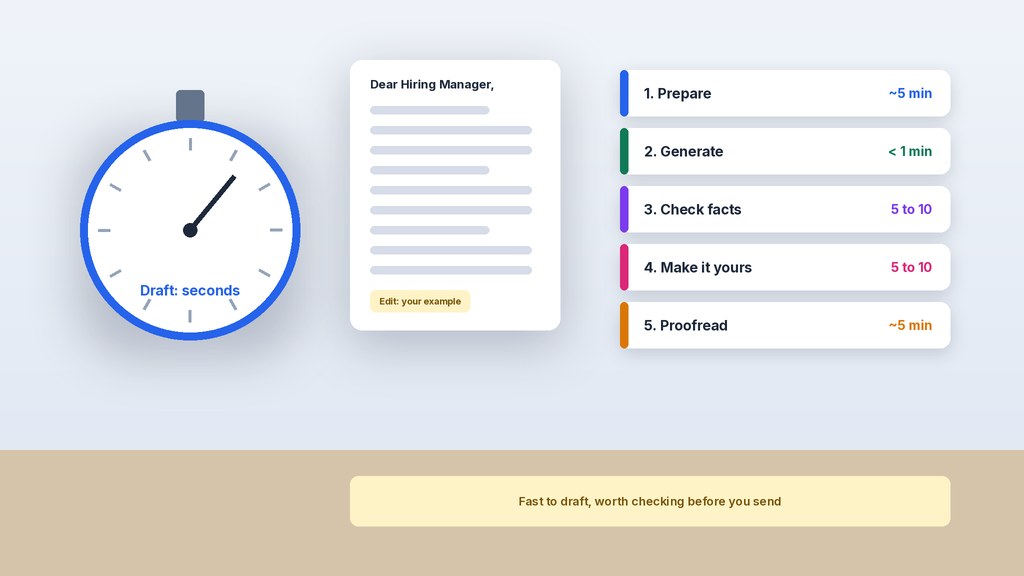
| Step | What you do | Suggested time |
|---|---|---|
| 1. Prepare | Open the advert, note the main requirements and have your CV ready | About 5 minutes |
| 2. Generate | Paste the advert, add your CV, choose a tone and create a draft | Under 1 minute |
| 3. Read and correct | Check every fact, name, date and claim against your real experience | 5 to 10 minutes |
| 4. Make it yours | Rewrite the opening, add one true example, remove stock phrases | 5 to 10 minutes |
| 5. Proofread and send | Read it aloud, check names and spelling, save the file | About 5 minutes |
That adds up to roughly 20 to 30 minutes for a letter you care about. For a quick edit on a role where a letter is optional, less may be enough. For a senior role or a competitive one, you may reasonably want longer.
What changes how long it takes
- Your CV. If your CV is accurate and up to date, the generator has good material and you will correct less.
- The advert. A clear advert with listed requirements is quicker to answer than a vague one.
- The role. Senior or specialist roles usually need more careful evidence and wording.
- Application rules. Some employers ask for a letter with a word limit, or ask specific questions in a form instead. Follow the instructions you are given.
- How much you rewrite. If the draft already sounds like you, editing is quick. If the tone is wrong, it takes longer.
- How many drafts you make. Generating several versions can help you compare tone, but reading each one carefully takes time too.
Where the time is worth spending
- Checking facts. A generator works from what you gave it. A wrong job title, date or skill is easy to miss and expensive to leave in.
- One real example. A specific story that links to the main requirement does more than a paragraph of general claims.
- The opening. The first two sentences are what a reader sees first. Write them in your own words and mention the actual role and employer.
- Cutting. Removing generic phrases usually makes a letter shorter and stronger. Our guide to UK cover letter length helps you decide how much to keep.
Where you can save time
- Keep a master CV. A tidy, accurate CV means less to fix in each letter.
- Keep a short list of real examples. Three or four stories you can drop into a letter save you from thinking of one from scratch each time.
- Choose roles carefully. A letter takes the same effort whether the role suits you or not, so spend it on jobs you genuinely fit.
- Check the match first. Seeing the gaps between your CV and the advert before you write shows you what the letter should address.
- Skip it when it is not needed. If the advert does not ask for a letter and the application form has space to say why you fit, you may not need one.
Mistakes that waste time or hurt the letter
- Sending the first draft. It is quick, but it is the version most likely to sound generic or contain something wrong.
- Regenerating again and again. Each new draft needs checking. It is often faster to edit one good draft.
- Reusing one letter for every role. Employers can tell when a letter is not about them. Adjust it for each advert.
- Claiming things you cannot discuss. If a point is in the letter, you may be asked about it at interview.
- Ignoring the instructions. A word limit, a required format or a specific question in the advert comes first.
For more on getting the voice right, see can an AI cover letter generator sound like you wrote it?
How CareerPilot can help
The CareerPilot cover letter generator asks for your CV, which you can upload as a PDF or Word file or paste as text, and the job description. You choose one of four tones: Professional, Creative, Confident or Humble. The feature page says it produces a letter in under 30 seconds, written in British English from your CV and the advert.
Alongside the draft you see a keyword match figure and a word count. The missing keywords are a prompt, not an instruction: only add a term if it is true for you. You can download the letter as a Word document, which is the easiest way to edit it, or as a PDF, and letters are saved to your account.
According to the CareerPilot pricing page, the cover letter generator is included on the Career Focus plan, listed at £12.99 a month, and on Career Growth, and it is not included on the Free plan. Before you write, you can check how your CV reads against the advert with the ATS scanner, find roles in trusted live jobs, and note which letter you sent in the job tracker.
FAQ
How long does it take to write a cover letter with AI?
The AI draft usually takes seconds to a minute. Reading it, correcting facts, adding one real example and proofreading usually takes longer, and as a rough planning guide you might allow about 20 to 30 minutes for a letter you care about.
Is it faster to write a cover letter with AI than by hand?
The first draft is much faster. Whether the whole task is faster depends on how much you need to correct and rewrite, so the saving is largest when your CV is accurate and the advert is clear.
Can I send an AI cover letter without editing it?
It is better not to. Check every fact, replace generic phrases and add one specific example, because you are responsible for everything the letter says.
How many times should I regenerate an AI cover letter?
Once or twice is usually enough to compare tone. After that it is normally quicker to edit the best draft than to keep generating new ones.
Do I need a cover letter for every application?
Not always. If the advert does not ask for one and the application form lets you explain why you fit, you may not need one. When a letter is requested, follow the instructions given.
Can an AI cover letter promise me an interview?
No. A clear, accurate and relevant letter can help your application, but the outcome depends on the employer, the other applicants and the role.
One last thing
Writing a cover letter with AI is quick to start and worth finishing properly. Let the generator give you a first draft in seconds, then spend a short, focused amount of time checking it is true, adding one real example and making it sound like you. Fewer, better applications: live employer listings matched to your real CV.
Related guides
🚀 Ready to transform your UK job search?
Try CareerPilot's free or — built specifically for the UK market.