Do you need a cover letter if the advert doesn't ask for one?
Do you need a cover letter if the advert doesn't ask for one? When a short letter helps, when to leave it out, and how to write one that is worth reading.
Written by Nancy Osazee, Founder of CareerPilot.
If a job advert only asks for your CV, you do not have to send a cover letter. But "not asked for" is not the same as "not wanted". When there is somewhere to put one, a short, specific letter can explain things a CV cannot, such as why you want this role, why you are changing career or why there is a gap in your history. There are also times when adding a letter is pointless or even works against you. This guide explains how to decide, what to do when there is no upload field, and how to write a short letter that is worth the reader's time.
- If the advert only asks for a CV, a cover letter is optional, not required.
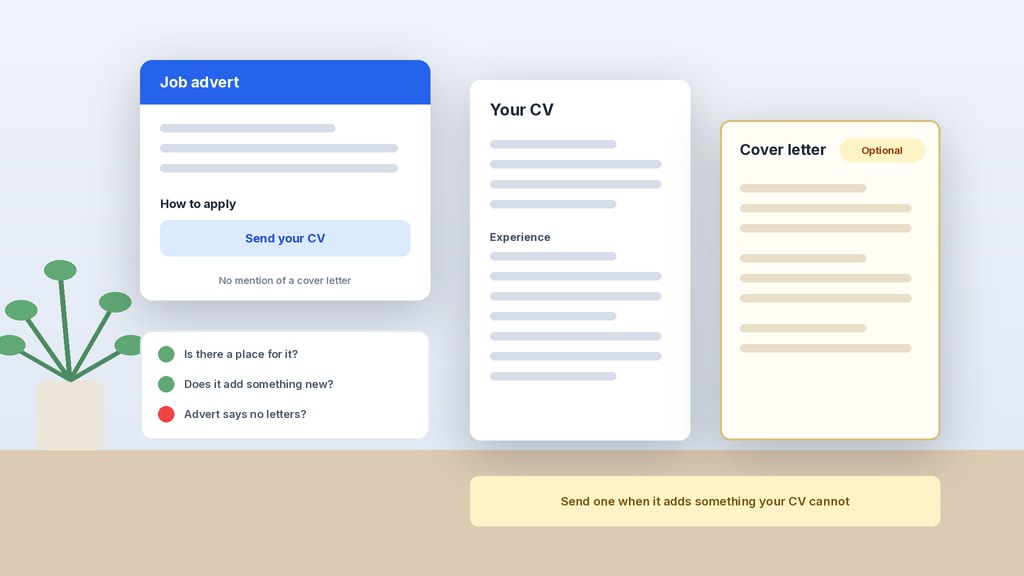
- Send a short one when there is a place for it and it adds something your CV cannot, such as context for a career change or a gap.
- Leave it out if the advert says not to, if the form has no place for it, or if a supporting statement replaces it.
- A focused letter of three or four short paragraphs, written for that one role, is better than a long generic one.
Why this matters
Many adverts now say only "apply with your CV", and many online systems never mention a cover letter at all. That leaves job seekers guessing. Some spend an hour writing a letter nobody asked for; others skip it on applications where it could have made the difference between a quick no and a closer look.
Employers and recruiters differ. Some read every cover letter, some only read them for shortlisted candidates, and some never open them. You cannot know which kind you are dealing with, so the better question is not "will they read it?" but "if they do, will it help?"
Do you need a cover letter if the advert doesn't ask for one?
No, you do not need one. Leaving it out will not usually count against you when the employer has only asked for a CV. But a good cover letter is often worth sending anyway when three things are true:
- There is a sensible place for it. An upload field for extra documents, an "additional information" box, or an application by email.
- It adds something new. It explains your motivation, links your experience to the role or gives context your CV cannot.
- You can write it for this role. A letter that could be sent to any employer adds little and can make your application look rushed.
If any of those is missing, your time is usually better spent tailoring your CV to the advert instead.
When a cover letter is worth sending anyway
- You are changing career. Your CV shows what you have done; a letter can explain why it fits a different kind of role. For more, read our career change cover letter guide.
- You have a gap or an unusual history. A sentence or two of context can stop a reader making assumptions.
- You are applying by email. The email itself works as a short cover letter, so make it count rather than writing "please find attached".
- The employer is small. In a small business the person reading your application may well be the person you would work for, and a personal note can help.
- You are relocating or want to explain timing. For example, when you can start or why you are applying for a role in a new area.
- You are writing to an employer without an advert. A speculative application needs a letter, because there is no advert to explain why you are getting in touch. Our speculative cover letter guide covers this in detail.
When to leave it out
- The advert says not to send one. Follow the instructions. Ignoring them suggests you do not read carefully.
- There is nowhere to put it. Do not force a letter into a field meant for something else.
- A supporting statement replaces it. Many public sector forms, including NHS and Civil Service applications, ask for a supporting or personal statement instead. Put your effort there. Our guide to supporting statements for NHS and Civil Service roles explains how.
- You would only be repeating your CV. If the letter just lists your jobs again, it adds reading time without adding value.
- You do not have time to tailor it. A generic letter is not better than no letter.
What to do when there is no upload field
Online application systems vary, so look closely at the form before you decide.
- Check for an extra documents or additional information field. This is often the right place for a short letter or a few lines of context.
- Keep it short in a text box. If a box has a character limit, write two or three sentences that link your experience to the role, rather than pasting a full letter.
- Do not merge files unless asked. Adding a letter as the first page of your CV file can confuse the reader or the system. Only combine documents if the instructions tell you to.
- Use the email or message if there is one. If the advert gives a contact, a brief, polite message can do the same job as a letter.
How to write a short cover letter that is worth reading
When a cover letter is optional, the reader owes you nothing, so get to the point. Three or four short paragraphs on less than a page is plenty. For more detail on length, read how long a UK cover letter should be.
- Opening. Name the role and say in one sentence why you are a good fit.
- Evidence. Pick two or three requirements from the advert and give a true, specific example for each.
- Context, if needed. Briefly explain a career change, a gap or your availability. Keep it factual and positive.
- Close. Thank them, and say you would welcome the chance to talk about the role.
Address the letter to a named person if the advert gives one. If not, "Dear Hiring Manager" is fine. Use the same words the advert uses where they are true for you, and check that every claim matches your CV.
Common mistakes with optional cover letters
- Writing one letter for every job. Readers can usually tell, and it suggests you are applying everywhere.
- Starting with yourself instead of the role. Lead with what the employer needs and how you meet it.
- Making it too long. A letter nobody asked for should be quick to read.
- Using a different name or job title. If you adapt a previous letter, check every detail before you send it.
- Overstating your experience. Anything you write may come up at interview.
Where CareerPilot fits
The CareerPilot cover letter generator drafts a letter from the job description you paste in, in one of four tones: Professional, Creative, Confident or Humble. You can edit the draft in your browser and export it as PDF or Word. Treat it as a first draft: check every sentence is true for you and add your own examples before you send it. According to the CareerPilot pricing page, cover letter generation is included on the Career Focus and Career Growth plans.
An optional letter is most worth writing for roles you genuinely want. Start from trusted live jobs listed from employer sites, and record which version of your CV and letter went where in the job tracker.
FAQ
Do you need a cover letter if the advert doesn't ask for one?
No. If the advert only asks for a CV, a cover letter is optional. It is often worth sending a short one if there is a place for it and it adds something your CV cannot, such as context for a career change or a gap.
Will sending a cover letter that was not requested count against me?
It is unlikely to, as long as it is short, relevant and in the right place. It can count against you if the advert says not to send one or if the letter is generic.
Do recruiters read cover letters?
Some do and some do not, and practice varies between employers. Because you cannot tell in advance, write a letter that would help if it is read, and make sure your CV stands on its own.
What if the online form has no space for a cover letter?
Look for an additional information or extra documents field. If there is none, do not force a letter into another field. Focus on tailoring your CV instead.
Should I attach a cover letter to the same file as my CV?
Only if the instructions tell you to. Otherwise, keep them as separate documents or use the email or message as your cover letter.
How long should an optional cover letter be?
Short. Three or four paragraphs on less than a page is plenty, because the reader did not ask for it and will want to see the point quickly.
One last thing
A cover letter is optional when the advert only asks for a CV, so treat it as a tool rather than a rule. Send a short, specific letter when there is a place for it and it adds something new; leave it out when the employer says no, the form has no room, or a supporting statement does the job instead. Either way, a CV tailored to the advert matters most. Fewer, better applications: live employer listings matched to your real CV.
Related guides
🚀 Ready to transform your UK job search?
Try CareerPilot's free or — built specifically for the UK market.