Can an AI cover letter generator sound like you wrote it?
Can an AI cover letter generator sound like you wrote it? What shapes the voice of an AI draft, the giveaways recruiters notice and how to make it yours.
Written by Nancy Osazee, Founder of CareerPilot.
An AI cover letter generator can sound like you wrote it, but rarely on the first draft and never without your input. The tool can only work with what you give it: your CV, the job description and any tone you choose. If your CV is thin or generic, the letter will be too. The drafts that sound most like a real person are the ones where the writer adds a specific example, cuts the stock phrases and reads the result aloud before sending. This guide explains what shapes the voice of an AI draft, the giveaways recruiters tend to notice, and a simple editing routine that turns a generated draft into a letter that is genuinely yours.
- An AI generator writes from your CV, the job description and the tone you pick, so better inputs give a draft that sounds more like you.
- Common giveaways include stock openings, inflated adjectives, claims your CV does not support and a rhythm that sounds the same in every paragraph.
- Treat the output as a first draft: add one real example, swap generic phrases for your own words and check every claim against your CV.
- Reading the letter aloud is the quickest way to hear whether it sounds like you.
Why this matters
A cover letter is often the first place an employer hears your voice. A CV lists what you have done; a letter explains why you want this role and how your experience fits it. If the letter reads as though it could have been sent by anyone, it misses the one job it has.
AI tools can save you from the blank page, which is a real help when you are applying for several roles, changing career or returning after a break. The risk is sending a letter that is polished but empty. The goal is not to hide that you used a tool. It is to send a letter that is accurate, specific and recognisably yours.
Can an AI cover letter generator sound like you wrote it?
Yes, with your help. An AI generator predicts likely sentences based on the material you give it. It does not know how you speak, which project you are proudest of or why this employer appeals to you, unless that information is in your CV or you add it yourself. What it can do well is structure a letter, pick out the requirements in an advert and suggest how your experience might answer them.
So the honest answer is that a generator gets you a solid starting point. Whether the final letter sounds like you depends on the few minutes you spend editing it.
What shapes the voice of an AI draft
1. Your CV
The generator borrows your achievements, job titles and skills from your CV. If your CV says "responsible for customer service", the letter has little to work with. If it says you handled complaints for a busy branch and cut repeat calls by changing how follow-ups were logged, the letter can tell a real story. Improving your CV often improves every letter you generate from it.
2. The job description
Most generators read the advert and mirror its priorities and wording. That helps the letter stay relevant, but it can also make the letter sound like the advert rather than like you. Copying the employer's exact phrases in every sentence is a common reason a letter feels mechanical.
3. The tone you choose
Many tools let you choose a tone, such as formal or warm. Pick the one closest to how you would speak in a good interview. A confident tone can suit a sales role; a warmer tone can suit care or support work. If none feels right, choose the plainest option and add personality in your edits.
4. What you add yourself
A sentence only you could write, such as why you want to work for this organisation or a moment that made you choose this field, does more for your voice than any setting in the tool.
Signs a cover letter was generated and not edited
Recruiters read a lot of letters. None of these signs proves a letter came from AI, but several together make a letter feel generic, and that is the real problem.
| Giveaway | Why it hurts | What to do instead |
|---|---|---|
| Stock opening such as "I am writing to express my strong interest" | It could start any letter for any job | Open with the role and one specific reason you want it |
| Stacked adjectives such as "highly motivated, dynamic, results-driven" | Claims without evidence are easy to skip | Replace them with one short example of what you did |
| Achievements that are not on your CV | The interviewer may ask about them | Delete anything you cannot explain and back up |
| Every paragraph the same length and rhythm | Reads as templated | Vary sentence length; keep one short, direct line |
| The advert's wording repeated word for word | Sounds like the employer, not you | Use their key terms once, then explain in your own words |
| A formal register you never use | Feels unlike you at interview | Write the way you would speak to a respected manager |
How to make an AI cover letter sound like you
- Start with a stronger CV. Add specific results and context to your CV first. The generator can only reuse what is there.
- Paste the full advert. Include the duties and the person specification, not just the job title, so the draft focuses on what this employer asked for.
- Choose the plainest tone that fits. It is easier to add warmth to a plain draft than to remove gloss from an over-the-top one.
- Rewrite the first two lines yourself. Say which role you are applying for and one genuine reason it interests you.
- Add one real example. Pick the requirement that matters most and describe a situation where you showed it: what happened, what you did, what changed.
- Cut what you would not say. Remove phrases you would never use out loud and anything you could not talk about in an interview.
- Read it aloud. Any sentence you stumble over or would not say to a person needs rewriting.
- Check the facts. Names, dates, job titles and the employer's name should all be correct. Generators can get small details wrong.
Quick before and after
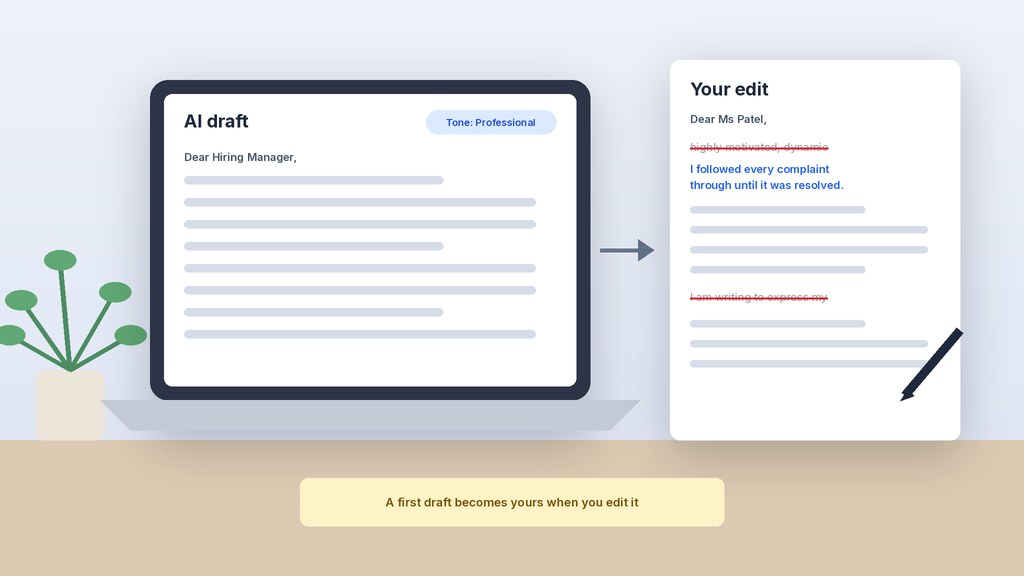
Here is the kind of change that makes the difference. A typical generated line might read: "I am a highly motivated professional with a proven track record of delivering exceptional customer experiences." After editing, the same idea could become: "In my two years on the front desk at a busy leisure centre, I became the person colleagues passed complaints to, because I would follow them up until they were resolved." The second version is plainer, more specific and much more likely to sound like you. Only use details that are true for you.
Is it acceptable to use AI for a cover letter?
For most private sector roles in the UK, using a tool to help draft a letter is similar to asking a friend to look over it, provided everything in it is true and you can talk about it at interview. Some employers and application forms do set their own rules, for example asking you to confirm that answers are your own work, and some public sector application processes include guidance on the use of AI. If an application gives instructions, follow them.
Length matters too. A generated letter can run long. For guidance on keeping it tight, read how long a UK cover letter should be.
How the CareerPilot cover letter generator works
The CareerPilot cover letter generator asks for two things: your CV, which you can upload as a PDF or Word file or paste as text, and the job description. You then choose one of four tones: Professional, Creative, Confident or Humble. The letter is written in British English from your CV and the advert.
Alongside the draft, you see a keyword match figure showing which key terms from the advert appear in the letter and which are missing, plus a word count. The missing list is a prompt, not an instruction: only add a term if it is true for you. You can download the letter as a Word document, which is the easiest way to edit it into your own voice, or as a PDF. Letters are also saved to your account so you can find them again.
A letter is most worthwhile for a role you genuinely fit. Start with trusted live jobs listed from employer sites, check your CV against the advert with the ATS scanner, then generate and edit your letter. The job tracker helps you record which version you sent to whom.
FAQ
Can recruiters tell if a cover letter was written by AI?
Sometimes they suspect it, usually because the letter is generic rather than because of any test. A letter with a specific example, accurate details and natural wording is far less likely to raise that question.
Will an AI cover letter generator use my real experience?
It uses what is in your CV and anything else you provide. It cannot know experience you have not written down, so add missing examples to your CV or to the letter yourself.
Is it cheating to use an AI cover letter generator?
Not in itself, unless the employer has told you not to use AI. Make sure every claim is true, that you can discuss it at interview, and that you follow any instructions in the application.
Should I tell the employer I used AI to write my cover letter?
There is usually no need unless the application asks. What matters is that the content is accurate and you stand behind it.
How do I stop an AI cover letter sounding generic?
Rewrite the opening yourself, add one real example linked to the main requirement, remove stock phrases and read it aloud before sending.
Can I use the same AI cover letter for every job?
It is better not to. Generate or adjust a letter for each role using that advert, because the strongest letters answer what a specific employer asked for.
One last thing
An AI cover letter generator can give you a clear, relevant first draft in far less time than starting from nothing. Making it sound like you is still your job: add one true story, cut the stock phrases and read it aloud. Spend that effort on roles you genuinely fit. Fewer, better applications: live employer listings matched to your real CV.
Related guides
🚀 Ready to transform your UK job search?
Try CareerPilot's free or — built specifically for the UK market.