Why do companies post jobs they are not actively hiring for?
Why do companies post jobs they are not actively hiring for? The common reasons behind ghost jobs in the UK, the signs to look for and how to save time.
Written by Nancy Osazee, Founder of CareerPilot.
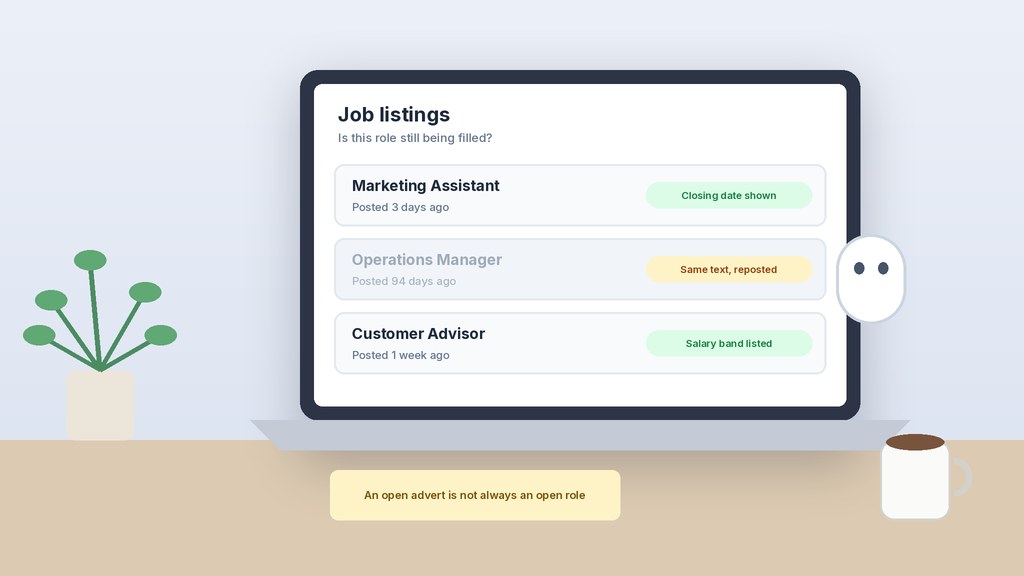
Companies post jobs they are not actively hiring for for a handful of ordinary reasons: the role was filled and the advert was never taken down, the hiring budget was paused after the advert went live, the employer wants a pool of CVs for future vacancies, or an internal candidate is already lined up but the role still has to be advertised. Sometimes the employer is not the one keeping the advert alive at all; copies on job boards and aggregator sites can outlive the original. These adverts are often called ghost jobs. This guide explains why they happen, how to spot the warning signs and how to spend your effort on roles that are genuinely open.
- Most ghost jobs come from ordinary causes: filled roles left online, paused budgets, CV collecting for future roles, and internal hires that still need an external advert.
- Copies of an advert on aggregator sites can stay live after the employer has closed the role on its own careers page.
- Warning signs include an old or repeatedly reposted advert, no closing date, a vague description and a role that is missing from the employer's own site.
- No single sign proves an advert is a ghost job, so check the employer's careers page before you spend an evening tailoring a CV.
Why this matters
If you are applying steadily and hearing very little back, it is natural to assume the problem is your CV. Sometimes it is. But some of the silence comes from adverts that were never going to lead to an interview, because nobody was actively filling the role when you applied.
Knowing why ghost jobs exist will not make them disappear, but it helps you decide where to put your time. A tailored application takes real effort. Spending that effort on roles that are open, current and a good fit is the core of a calmer job search: fewer, better applications rather than more of them.
Why do companies post jobs they are not actively hiring for?
In most cases it is not a deliberate attempt to mislead. Recruitment involves several people, several systems and several job boards, and adverts are easy to post and easy to forget. Below are the reasons that come up most often. Several can apply to the same advert at once.
1. The role was filled and the advert was left up
A hiring manager makes an offer, the candidate accepts, and everyone moves on. Closing the advert on every board is nobody's top priority. The listing can stay visible for weeks, still collecting applications for a job that no longer exists.
2. The budget or approval changed after posting
Roles are sometimes advertised before final sign-off, or a hiring freeze arrives after the advert goes live. The employer may intend to hire when the budget returns, so the advert stays up, but nobody is reviewing applications in the meantime.
3. Building a pool of CVs for later
Some employers and recruitment agencies run "evergreen" or pipeline adverts for roles they hire into regularly, such as customer service, care or sales. The aim is to have suitable people ready when a vacancy opens. That is not always a bad thing for you, but it does mean there may be no specific job behind the advert today. Wording such as "register your interest" or "for future opportunities" is a clue.
4. An internal candidate is already preferred
Some organisations have policies that require roles to be advertised externally, even when a strong internal candidate is expected to get the job. The external advert is real in a procedural sense, but your realistic chance may be lower than the listing suggests.
5. Testing the market or showing growth
Occasionally an employer advertises to see who is out there, to benchmark salaries, or simply to look busy to customers and investors. These motives are hard to prove from the outside, so treat them as a possibility rather than a conclusion.
6. Copies outlive the original advert
Many job sites copy adverts from other sources. When the employer closes the role on its own careers page, those copies are not always updated straight away. You may be applying through a listing that the employer itself stopped advertising some time ago.
Ghost job, fake job or slow hiring?
These are easy to confuse, and they call for different responses.
| Type | What is going on | What to do |
|---|---|---|
| Ghost job | A real employer, but no active hiring for this advert right now | Check the employer's own careers page and whether the advert is current before you invest time |
| Fake job ad | Not a job at all; the aim is usually a fee, your documents or your data | Do not pay, do not send identity documents, and stop replying |
| Slow hiring | A genuine role where the process is simply taking a long time | Follow up politely once, then keep applying elsewhere |
If an advert asks you for money or identity documents up front, read how to spot fake job ads and ghost jobs in the UK before doing anything else.
Signs an advert may not be actively hiring
None of these signs proves an advert is a ghost job on its own. Two or three together are a reason to check before you apply.
- The advert is old. A role that has been live for months with the same text deserves a second look.
- It keeps being reposted. The same title and wording reappearing every few weeks can point to pipeline hiring or a role that is hard to fill.
- There is no closing date. Many genuine adverts lack one, but combined with other signs it matters more.
- The description is vague. No team, no clear duties and no location detail can suggest a generic advert rather than a specific vacancy.
- The role is missing from the employer's site. If the company's own careers page does not list it, the copy you found may be out of date.
- The apply link is broken or redirects to a general page. That often means the original listing has been removed.
How to protect your time
- Go to the source. Search the employer's own careers page for the role. If it is there with the same details, you are on firmer ground.
- Check the date. Prefer adverts with a recent posting date or a closing date that has not passed.
- Apply once, through one route. Sending the same CV through several boards does not make a role more real, and it can confuse the employer's records.
- Prioritise fit. Spend your best effort on roles where you meet the essential criteria. A strong fit for an open role beats ten rushed applications.
- Set a time limit. If you have not heard back after a reasonable period, follow up once, record the outcome and move on.
- Keep a record. Note where and when you applied. Patterns, such as a source that never replies, become easier to see.
How CareerPilot helps you avoid ghost jobs
The free CareerPilot ghost job detector lets you paste any listing, from any site, and see the warning signs it can find in plain English, such as a hidden employer, pipeline wording, advert age or reposts it has seen before. You do not need an account. The result is not proof that a job is real or fake; it shows you what raised a concern so you can decide.
If you would rather start from a cleaner list, trusted live jobs on CareerPilot are listed from employer sites, and listings are checked regularly. A listing can still be out of date, so always confirm the advert on the employer's page before you apply.
Once you have found a role worth your time, the CareerPilot ATS scanner compares your CV with that job description, and the job tracker keeps a simple list of where you applied, the status and your notes.
FAQ
What is a ghost job?
A ghost job is an advert for a role the employer is not actively filling. The company is usually real, but the role may already be filled, paused, or advertised mainly to collect CVs for future vacancies.
Is a ghost job the same as a job scam?
No. A ghost job usually comes from a real employer that is not actively filling the role. A job scam is not a job at all and usually wants money, identity documents or personal data. If you think you have been targeted by fraud, report it to Action Fraud in England, Wales and Northern Ireland or to Police Scotland.
How common are ghost jobs?
There is no reliable official UK figure. Surveys that circulate online use different definitions and methods, so treat any single number with caution and focus on checking each advert you care about.
How can I tell if a job advert is still active?
Look for the same role on the employer's own careers page, check the posting and closing dates, and make sure the apply link works. A recent date and a matching listing on the employer's site are good signs, although neither is a guarantee.
Should I still apply to a job that might be a ghost job?
If the role is a strong fit and you have checked the employer's site, a short, honest application can still be worth it. Just avoid spending hours tailoring for an advert that shows several warning signs.
Why do recruitment agencies advertise roles that do not exist yet?
Agencies often advertise for roles they fill regularly so they have candidates ready when a client calls. Ask which client and which location the role is for; a clear answer is a good sign.
One last thing
Most ghost jobs are a by-product of busy hiring teams and copied adverts, not a personal snub. You cannot control which adverts stay online, but you can control where your effort goes. Check the source, favour current roles you genuinely fit, and keep a simple record. Fewer, better applications: live employer listings matched to your real CV.
Related guides
🚀 Ready to transform your UK job search?
Try CareerPilot's free or — built specifically for the UK market.