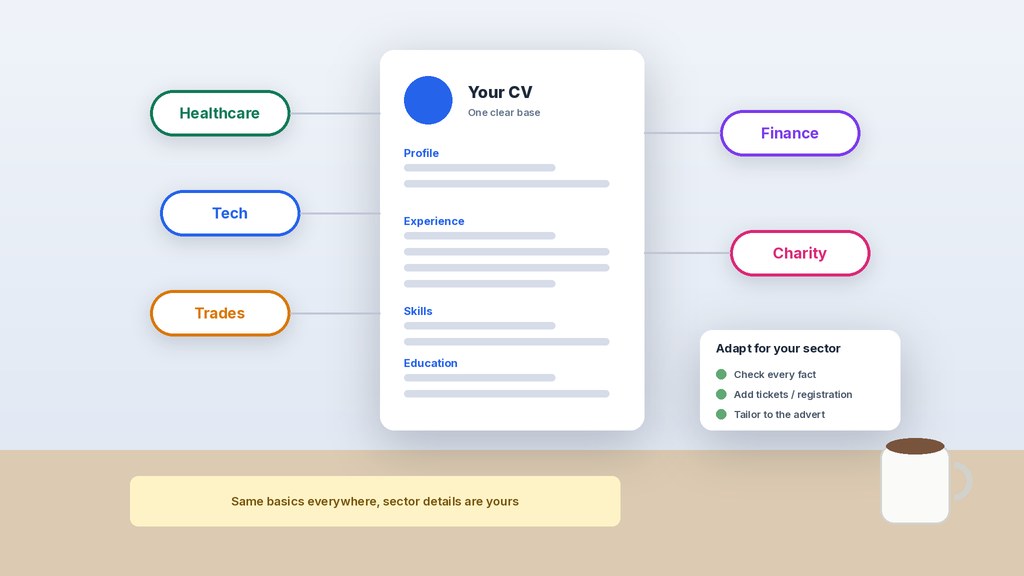
Can an AI CV builder work for any industry?
On CareerPilot: CV builder and ATS check
Can an AI CV builder work for any industry? See what carries across every sector, where roles differ, and how to check an AI-built UK CV before you send it.
Written by Nancy Osazee, Founder of CareerPilot.
An AI CV builder can turn your work history into a tidy, well-organised CV in a few minutes, whatever job you do. The harder question is whether the result suits your industry. A CV for a staff nurse, a software developer, an electrician and a finance analyst all need a clear layout and honest evidence, but what employers look for in each can be quite different. This guide explains what an AI CV builder does well in every sector, where it needs your help, and how to check the result before you apply. If you are still deciding how much to trust automated tools, our guide to whether a free CV checker is accurate enough to trust covers the same questions for checkers.
- An AI CV builder can help in almost any industry with layout, clear wording and a consistent structure, because those basics are the same everywhere.
- It is weaker on what makes your sector different, such as registration details, tickets and licences, portfolios, publications or criteria-based evidence.
- It can only work with what you give it, so a CV built from vague notes will read as vague, and any skill you did not mention should not appear in the result.
- Use it for a first draft, then check every line is true, add the sector-specific parts yourself, and tailor the CV to each advert.
Why this matters
Most AI CV builders are designed to work for everyone, which is useful and also the risk. A general tool is good at producing a CV that looks professional. It is much less likely to know that a hiring manager in your field wants to see a particular qualification near the top, or that a public sector application is scored against a person specification rather than skimmed for a story.
Knowing which parts a builder can handle, and which parts are your job, helps you save time without sending a CV that reads like everyone else's.
Can an AI CV builder work for any industry?
Yes for the basics, and only partly for the rest. The parts of a good UK CV that are the same in nearly every sector are the parts a builder handles well. The parts that depend on how your industry hires are the parts you need to check and finish yourself.
A useful way to think about it: an AI CV builder is good at presentation and wording, and you are the only source of truth for what you have done. It does not know your career unless you tell it, and it cannot decide what your next employer cares about most.
What carries across every industry
- A clean, readable structure. Contact details, a short profile, work history in reverse order, education and skills. Software and people both find this easiest to read.
- Clear headings and consistent dates. A builder keeps formatting consistent, which saves the small mistakes that creep in when you edit by hand.
- Plain wording. Turning a long paragraph of duties into short, active bullet points works in any field.
- Evidence of what you did. Every sector prefers specific examples to a list of responsibilities, and a builder can prompt you for them.
- Tailoring to the advert. Matching the language of the job description is useful whether you are applying to a hospital, a bank or a building firm.
Where industries differ
These are general patterns, not rules, and individual employers vary. Always read the advert and any guidance the employer gives, because it overrides any general advice.
| Sector | What employers often want to see | What a builder may miss |
|---|---|---|
| Healthcare and NHS | Registration or professional body details where relevant, relevant experience and evidence of values, often backed up in a supporting statement on the application form | Which details your role requires and how the application form uses your CV |
| Tech and software | Tools and languages, projects, links to work, and what you built | Your real level of experience with each tool, so only list what you can discuss |
| Finance and accounting | Qualifications, study progress, accuracy and the systems you have used | Professional bodies and exact qualification names |
| Trades and construction | Licences, tickets and cards, practical experience and recent site work | Certificates and expiry details that employers check |
| Charity and public sector | Evidence against stated criteria, values and volunteering | The exact wording of the person specification |
| Creative and media | A portfolio or link to work, alongside a short CV | The work itself, which no builder can create for you |
Where an AI CV builder can let you down
- Generic wording. Phrases such as "results-driven professional" could describe anyone, and recruiters read them all the time.
- Invented or inflated claims. Some tools fill gaps with skills or achievements you did not mention. Remove anything you cannot back up at interview.
- Sector gaps. A general tool may not know which qualification, ticket or registration your field expects to see.
- Over-polished layouts. Columns, icons, text boxes and graphics can look good to people and be harder for software to read.
- Sameness. If many people use the same template and the same suggested bullets, CVs start to look alike.
- Privacy. Your CV contains personal details. Check what a tool does with what you upload before you use it.
How to use an AI CV builder in any industry
- Gather the facts first. Write down your roles, dates, qualifications, tickets or registrations, tools and two or three real results for each job. The builder cannot invent what you have not given it.
- Read two or three adverts for the job you want. Note the skills and qualifications they repeat, and the words they use.
- Build a first draft. Give the tool your real details, and ask it to organise and tighten them rather than to add things.
- Check every line is true. Remove or correct anything that is not accurate, including skills, job titles and numbers.
- Add the sector-specific parts yourself. This might be registration details, licences, a portfolio link or a short list of projects.
- Tailor it to the advert. Use the employer's wording where it honestly describes you, and keep a master copy to adapt for each application.
- Check the file. Use a simple single-column layout and a standard file type, and look at the result on screen as a recruiter would.
Our guide to making an ATS-friendly CV that still appeals to a human recruiter explains how to keep the file easy for both.
What to look for in an AI CV builder
- Everything is editable. You should be able to change every word, add your own sections and remove anything the tool suggested.
- A file you can reuse. A standard export, ideally one you can edit again in a word processor, helps you tailor later.
- UK conventions. British English and UK date formats, and no photo or date of birth unless an employer asks.
- A plain layout. One column, ordinary headings and no text boxes.
- A clear data policy. Know what happens to your CV after you upload it.
- Honest promises. No tool can promise you an interview, and a builder that claims otherwise is not one to trust.
How CareerPilot can help
CareerPilot has a CV builder that you can use after you sign in. It is a simple form, not an AI writer: you type in your own summary, experience, skills and projects, and it exports a PDF. At the time of writing, the exported PDF uses headings such as Summary, Technical Skills, Experience, Projects, Certs and Education, which suits some roles more than others. If your sector expects different sections, keep a version in your own word processor as well.
The CareerPilot ATS scanner is where the checking happens. You paste a job description and upload your CV as a PDF or Word file, and you get a score out of 100, a keyword gap list and suggestions. The ATS scanner page also lists an AI rewrite of your bullet points. The gaps it shows are prompts, not instructions, so only add a term if it is true for you. The score is a guide to how well your CV matches one advert, not a prediction of whether you will be shortlisted.
According to the CareerPilot pricing page, the Free plan includes 5 CV scans a month. The paid plans include more scans, with unlimited scans on Career Growth, and the ATS scanner page says full CV rewriting is on paid plans. Check the pricing page for what your plan includes. To find roles worth tailoring for, browse trusted live jobs, which are listed from employer sites, and record each application in the job tracker so you know which version of your CV you sent.
FAQ
Can an AI CV builder work for any industry?
It can help with structure, clear wording and a consistent layout in almost any sector. It is less reliable on details that are specific to your field, such as registration, tickets, publications or criteria-based evidence, so you need to add and check those yourself.
Will an AI CV builder invent skills I do not have?
Some tools can add skills or achievements that you did not provide. Read every line and remove anything you could not explain or back up at an interview.
Is an AI-built CV good enough for applicant tracking systems?
A plain, single-column layout with standard headings is usually easier for software to read. No builder can promise that a CV will pass a particular system, so check it against the advert and keep the formatting simple.
Should I use the same AI-built CV for every job?
It is better to keep one accurate master CV and adapt it for each role, using the wording of the advert where it honestly describes you.
Is it safe to put my personal details into an AI CV builder?
Check the tool's privacy information first. Your CV usually holds your name, contact details and work history, so only use tools that explain how they store and use your data.
Can an AI CV builder guarantee I will get an interview?
No. A well-made CV can help you present your experience clearly, but the outcome depends on the employer, the other applicants and the role.
One last thing
An AI CV builder is a useful way to get a clear first draft in any industry, as long as you treat it as a draft. Give it true facts, add the details your sector expects, check every line and tailor the result to each advert. Fewer, better applications: live employer listings matched to your real CV.
Related guides
🚀 Ready to transform your UK job search?
Try CareerPilot's free or — built specifically for the UK market.