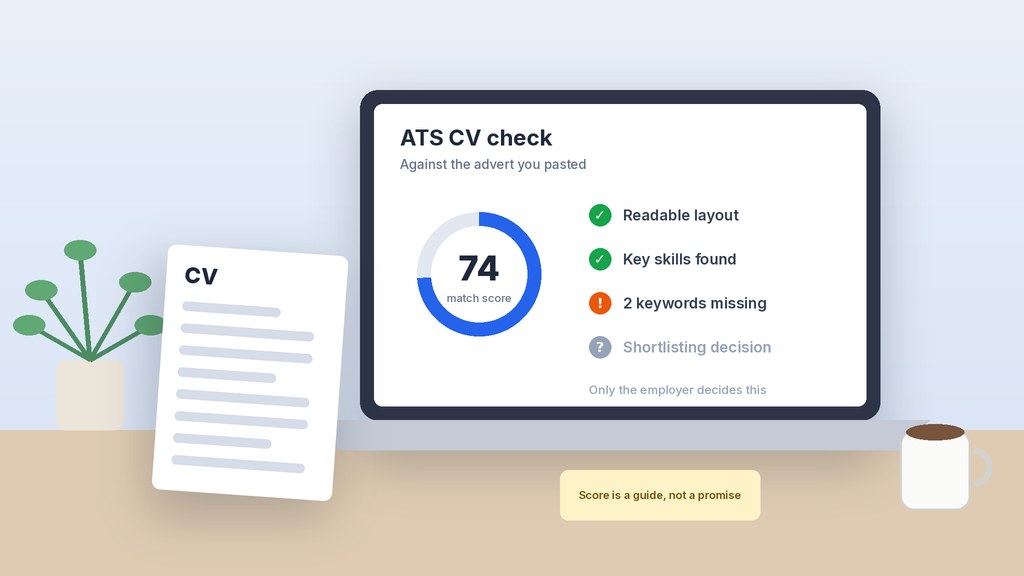
Can an ATS CV checker guarantee your CV gets through?
On CareerPilot: CV builder and ATS check
Can an ATS CV checker guarantee your CV gets through? No. See what a checker can tell you, what it cannot, and how to use one honestly on UK applications.
Written by Nancy Osazee, Founder of CareerPilot.
No. An ATS CV checker cannot guarantee that your CV gets through an employer's screening, and no honest tool should claim it can. A good checker can show you whether your CV is readable as text and how closely it lines up with one job advert. Whether you reach a shortlist depends on the employer's own system, their screening questions, the people reading applications and the other candidates. This guide explains what a checker can and cannot tell you, and how to use one without chasing a number.
- No ATS CV checker can guarantee your CV gets through, because it cannot see the employer's system settings, screening questions or shortlisting decisions.
- A checker is useful for spotting layout problems and gaps between your CV and the wording of one specific advert.
- Treat the score as a guide to editing, not a prediction of interviews.
- Only add keywords you can back up with real experience, and check the essential criteria before you apply.
Why this matters
When applications keep disappearing without a reply, a tool that promises to "beat the ATS" is tempting. Some sites suggest that a high score means your CV will pass and a low score means it will be rejected. That framing can push job seekers into rewriting a perfectly good CV for a number, or into adding skills they do not have.
Knowing the limits of an ATS CV checker saves time. You can use it for what it does well, then put the rest of your effort into the things that actually influence a shortlist: choosing roles you fit, meeting the essential criteria and showing clear evidence.
Can an ATS CV checker guarantee your CV gets through?
No. A checker compares your CV with a job advert using its own rules. The employer's applicant tracking system (ATS) uses different rules, set up by that employer, and a person usually makes the final call on who is shortlisted. The checker sees neither of those things.
What a checker can do is reduce avoidable problems. If your CV cannot be read cleanly as text, or it never mentions a skill the advert lists as essential, fixing that gives a human reviewer a fairer chance of seeing your fit. That is a real benefit. It is just not a guarantee.
Why no checker can promise a pass
1. Every employer sets up its system differently
ATS products are configured by each employer or recruiter. One may rank applications by keyword relevance, another may simply store them for a recruiter to read in date order, and another may filter on answers to application questions. A third-party checker cannot know which set-up sits behind the advert you are looking at.
2. Screening questions often matter more than the CV
Many online applications ask about the right to work in the UK, notice period, location, driving licence, professional registration or salary expectations. If an answer does not meet a requirement the employer has set, the CV may never be weighed at all. No CV score changes that.
3. People make the shortlisting decision
Hiring managers and recruiters read applications, compare candidates and decide who to interview. They look at relevance, evidence, career story and sometimes internal factors you cannot see. A checker can make your CV easier to read; it cannot predict a person's judgement.
4. The vacancy itself can change
A role can be filled internally, paused, re-scoped or closed early when enough applications arrive. Some adverts stay online after hiring has stopped. Your CV can be well matched and still go nowhere for reasons that have nothing to do with it.
5. You are compared with other applicants
Shortlisting is relative. A strong CV for one vacancy can still sit behind candidates with closer experience. A checker scores your CV on its own, not against the rest of the pile.
What an ATS CV checker can reliably tell you
| Usually useful | Outside what a checker can know |
|---|---|
| Whether your CV text can be extracted cleanly | Which ATS the employer uses and how it is set up |
| Essential skills from the advert missing from your CV | How your application questions were answered and scored |
| Skills hidden in images, text boxes or headers | How many people applied and how strong they are |
| Unclear section headings or missing contact details | Whether the role is still actively being filled |
| Job titles and terms worded differently from the advert | What the hiring manager values most on the day |
Use the left column to make concrete edits you can check yourself. Ignore any tool that turns the right column into a confident promise.
Warning signs a checker is overselling
- It says your CV is "guaranteed" to pass, or promises that you will be invited to interview.
- It gives a simple pass or fail verdict for "the ATS", as if every employer used the same system.
- It quotes dramatic rejection percentages without saying where the figure comes from.
- It suggests adding tools, qualifications or job titles you do not have.
- It recommends hidden text, white font or pasted adverts to raise your score. Recruiters can see these tricks when they read the CV, and they damage trust.
A trustworthy check explains why it flagged something and leaves the decision to you.
How to use an ATS CV checker without chasing a score
- Start with a real, current advert. Pick a role you actually want and could do. A score against a vacancy you are not suited to only tells you what you already know.
- Check the essentials first. Read the essential criteria, location, hours and any licence or registration requirements before you edit anything.
- Run the check and read the reasons. Look at which terms are missing and whether parts of your CV did not read as text.
- Edit only what you can support. If the advert says "stakeholder management" and you have done it, name it and give an example. If you have not, leave it out.
- Read it as a person would. After editing, skim the first half page in thirty seconds. It should still sound like you and make sense to a recruiter.
- Save the version you send. Note the role, employer, date and file name so you know which CV a recruiter is holding if they call.
Where CareerPilot fits
The CareerPilot ATS scanner works the same honest way. You paste the job description, upload your CV and get a match score with missing keywords and suggestions for that advert. Free accounts include five CV scans a month, so it makes sense to save them for roles you are ready to tailor.
The score is a guide to editing. CareerPilot does not promise interviews or offers, and no score should be read as an employer's decision. To spend fewer applications on roles that were never a fit, start from trusted live jobs listed from employer sites, then check your CV against the ones that genuinely match. Listings are checked regularly, but always confirm the advert on the employer's page before you apply.
If you are sending several applications a week, the CareerPilot job tracker keeps a simple list of the role, company, link, status and your notes, so versions and dates do not blur together.
What else affects whether you hear back
If you are getting few responses even after a clean check, the issue is often upstream of the CV. Common causes include applying to roles where you miss an essential requirement, sending the same CV everywhere, applying to adverts that are old or no longer active, and leaving application questions vague. Fewer, better-targeted applications usually teach you more than a higher volume of near misses.
It also helps to remember that a quiet inbox is not proof your CV was "rejected by a robot". Many employers simply do not reply to every applicant.
FAQ
Can an ATS CV checker guarantee my CV will pass?
No. A checker uses its own rules and cannot see the employer's system settings, application questions or shortlisting decisions. It can help you fix readability and keyword gaps, which gives a human reviewer a fairer read, but it cannot promise a result.
Is a high ATS score worth aiming for?
A higher score against a specific advert usually means your CV mentions more of what that advert asks for. That is useful. Chasing a perfect score by adding terms you cannot support is not, because a recruiter will read the CV and may ask about every line.
Why did I get rejected when my ATS score was high?
The score only compares your CV with the advert text. Rejections can come from screening questions, other candidates with closer experience, an internal hire or a role that was paused. None of those are visible to a checker.
Do all UK employers use an ATS to reject CVs automatically?
No. Many employers use an ATS to collect and organise applications, and how much it filters depends on how they set it up. Smaller employers may read every CV themselves. Treat any claim that "the ATS" rejects most CVs with caution unless it comes with a clear source.
How often should I run an ATS CV check?
Run it once per serious application, against that advert, after you have confirmed you meet the essential criteria. Re-checking the same CV against the same advert many times rarely adds much.
What should I do if an ATS CV checker suggests skills I do not have?
Leave them out. If a skill is essential and you do not have it, that is a signal to think about whether the role is right for you now, or how you could build that skill, rather than a gap to paper over.
One last thing
An ATS CV checker is a useful proofreader for one job advert. It can make your CV clearer and more relevant, but it cannot open the door for you. Use it to remove avoidable problems, keep every claim honest, and spend your effort on fewer, better applications: live employer listings matched to your real CV.
Related guides
🚀 Ready to transform your UK job search?
Try CareerPilot's free or — built specifically for the UK market.