Can AI interview practice prepare you for panel interviews?
On CareerPilot: Interview practice
Can AI interview practice prepare you for panel interviews? What it helps with, what it cannot copy, and a simple plan to get ready for a UK interview panel.
Written by Nancy Osazee, Founder of CareerPilot.
Panel interviews can feel harder than a one-to-one conversation. There are several people to read, questions can come from different directions, and someone is often taking notes while you speak. AI interview practice can help with a lot of the preparation, especially getting your examples clear and saying them out loud. It cannot fully recreate sitting in front of a real panel, though. This guide explains what AI practice is good for, where it falls short, and how to combine it with other practice so you walk in ready.
- AI interview practice can help you prepare for a panel interview, but it cannot fully copy a real panel.
- It is useful for building strong examples, rehearsing out loud, using the STAR structure and getting feedback on what you said.
- It cannot recreate several people asking questions, real follow-up questions or the feel of a room, so add at least one mock panel with real people.
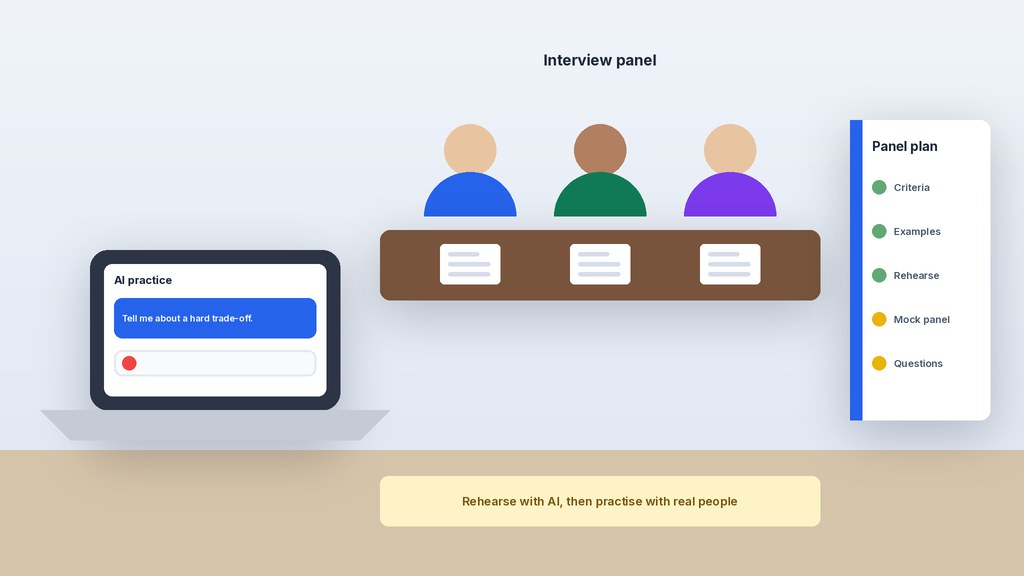
- A simple plan works best: learn the criteria, prepare your examples, rehearse with AI, then practise with two or three people.
Why this matters
Panel interviews are common in the UK, particularly for public sector, NHS, Civil Service, education and senior roles. If you have only ever had one-to-one interviews, the format can throw you. You might focus on the person who looks friendliest, lose your thread when someone starts writing, or forget who asked the question.
The good news is that most of what makes a panel interview go well can be practised. Your examples, your structure and your confidence speaking out loud all improve with repetition, and that is where AI practice can help.
What makes a panel interview different?
- Several interviewers. Usually two or more people, often from different teams or with different roles in the decision.
- Shared questions. Each panel member may take a different area, such as experience, values or technical knowledge.
- Scoring against criteria. Many panels, especially in the public sector, score each answer against the criteria in the job description or person specification.
- Note-taking. Someone may be writing while you talk. It is normal and is not a sign that the answer is going badly.
- Fewer reactions. Panel members may keep neutral faces so that every candidate is treated the same, which can feel cold.
- Follow-up questions. A different person may ask you to say more about an answer, so you need to be ready to go deeper.
Can AI interview practice prepare you for panel interviews?
Partly, yes. AI interview practice is good at the parts of preparation that depend on you: knowing your examples, structuring your answers and getting used to saying them out loud. Those are the same skills a panel is assessing. What it cannot do well is recreate the social side of a panel, such as reading several faces, handling interruptions or dealing with an unexpected follow-up from someone who was quiet until then.
So the best way to think about it is as rehearsal, not a dress rehearsal. Use AI practice to get your content ready, then use real people to practise the format.
What AI interview practice can help with
- Building your examples. Panels usually want specific stories about what you did. Practising helps you find gaps in your examples before the day.
- Using a clear structure. Feedback on situation, task, action and result helps you give focused answers rather than long ones.
- Speaking out loud. Answers that sound fine in your head often come out muddled. Rehearsing aloud fixes that.
- Keeping to time. Panels often have a set number of questions to get through, so concise answers matter.
- Repetition without pressure. You can practise as often as you like, at any time, without needing to book anyone.
- Values and competency questions. Many panel interviews use these, and they are well suited to practice because they ask for real examples.
What AI interview practice cannot copy
- Several real people. Practice tools usually give you one interviewer, so you do not get used to shifting your attention between people.
- Eye contact and body language. Knowing where to look, and including the whole panel in your answer, needs real faces.
- Unplanned follow-ups. Many tools ask set questions. A real panel member may probe a detail you did not expect.
- The organisation's own criteria. A tool does not know exactly how this employer will score you, so always work from the job description.
- The room itself. Arriving, sitting down, taking water and pausing to think in front of several people are best practised in person.
| AI interview practice | Mock panel with real people | |
|---|---|---|
| Best for | Content, structure and rehearsing out loud | Format, eye contact and follow-ups |
| Availability | Whenever you have time | Needs two or three people to give up their time |
| Questions | Usually set questions for a type of role | Can be tailored and can change in the moment |
| Feedback | On what you said in the session | On how you came across to each person |
A simple plan to prepare for a panel interview
- Read the job description and person specification. List the criteria the panel is likely to score you against.
- Prepare six to eight examples. Choose stories that cover those criteria, and make sure each has a clear result. Our guide to competency questions using the STAR method shows how.
- Rehearse with AI practice. Answer out loud, look at the feedback and tighten any example that runs long or misses a result.
- Run one mock panel with real people. Ask two or three friends or colleagues to take a question area each, and to ask at least one follow-up.
- Practise including everyone. Start your answer looking at the person who asked, then bring in the others as you go.
- Prepare for the format. Find out whether there is a presentation or a test, and practise that separately.
- Prepare your own questions. Have two or three ready, and think about which panel member each one is best aimed at.
Tips for the day
- Note names and roles. If they are introduced, jot them down so you can direct answers and questions to the right person.
- Do not be put off by note-taking or neutral faces. They are part of a fair process.
- Pause before you answer. A few seconds to think is fine, and it often leads to a better answer.
- Ask for a question to be repeated if you need to. It is better than answering the wrong question.
- Follow up afterwards. A short, polite email is a good way to finish. Our interview follow-up email guide has examples.
If your panel is for a public sector role, our guides to NHS values interviews and Civil Service interview questions go into more detail.
How CareerPilot can help
The CareerPilot interview coach is AI interview practice that you can use as part of this plan. You choose a track, including competency-based, NHS and public sector, management and leadership, and a senior and executive track written as a board-style panel. The interviewer reads each question aloud in a recorded British voice, and you speak or type your answers. When you finish, you get a score out of 100 and notes on each answer, including whether you used the STAR structure.
It is honest to say what it does not do. You hear one interviewer, not several, and the questions on each track are set in advance and are the same for everyone, so it will not ask a follow-up based on what you said. That is why the plan above includes a mock panel with real people. The score is feedback on your practice session, not a prediction of a real interview.
According to the CareerPilot pricing page, the interview coach is included on the Career Growth plan, listed at £24.99 a month, and not on the Free or Career Focus plans. You can find roles to prepare for in trusted live jobs, listed from employer sites, and keep track of your interview dates in the job tracker.
FAQ
Can AI interview practice prepare you for panel interviews?
Partly. It helps you prepare your examples, structure your answers and rehearse out loud, which are the skills a panel assesses. It cannot fully recreate several people, real follow-up questions or the feel of the room, so add a mock panel with real people.
How many people are usually on an interview panel?
It varies by employer, but a panel has at least two people and often three. They may come from different teams and each may take a different area of questions.
Who should I look at when answering a panel question?
Start by looking at the person who asked the question, then include the other panel members as you continue your answer, and return to the person who asked as you finish.
Is it bad if the panel is taking notes while I talk?
No. Note-taking is a normal part of many panel interviews, especially when answers are scored against set criteria. It is not a sign that your answer is going badly.
How can I practise for a panel interview at home?
Rehearse your examples out loud, using AI practice or by recording yourself, then ask two or three friends or colleagues to act as a panel, each taking a question area and asking at least one follow-up.
Can AI interview practice guarantee I will pass a panel interview?
No. Practice can help you prepare, but the result depends on the employer, the other candidates and the role. Treat any practice score as feedback, not a prediction.
One last thing
AI interview practice is a useful way to get ready for a panel interview, as long as you know its limits. Use it to sharpen your examples and rehearse out loud, then practise the format with real people, and work from the job criteria throughout. Fewer, better applications: live employer listings matched to your real CV.
Related guides
🚀 Ready to transform your UK job search?
Try CareerPilot's free or — built specifically for the UK market.